
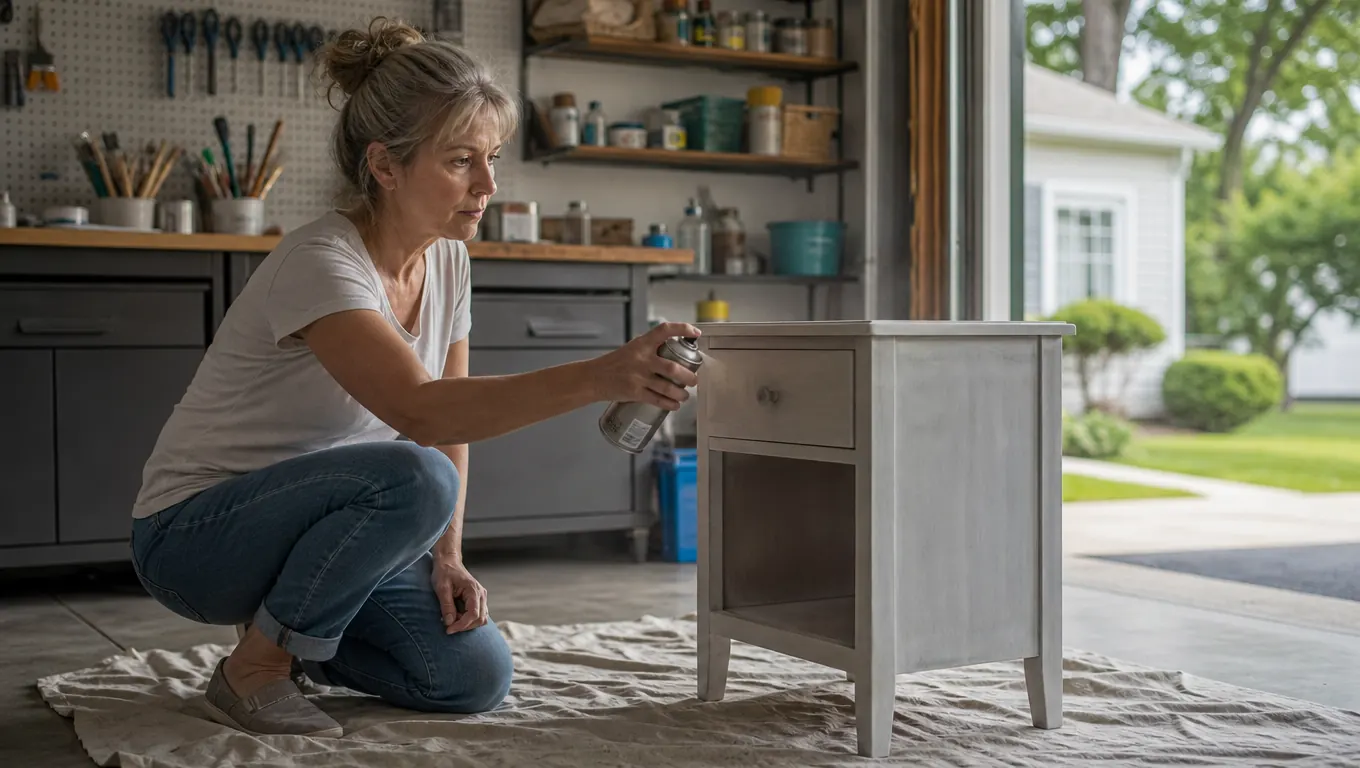
The nightstand cost me twelve dollars at a church garage sale back in May, the big one they hold every year on the second Saturday. I had already walked the whole gymnasium once and was on my second lap when I spotted it under a folding table with a price tag taped to the drawer front. The veneer was peeling on one corner, the drawer stuck about halfway out, and the finish had that orangey-brown look that dates a piece faster than anything. I almost walked right past it. But I pulled the drawer out and checked the back edge of the wood, and there was real oak veneer under the mess. The bones were good, and I had been wanting to try the Rust-Oleum Chalked Spray Paint ever since a friend used it on a bookshelf. So I loaded it into the trunk, brought it home, and set it in the garage next to my workbench.
If you have an old piece of furniture sitting in your basement or waiting at the curb for trash day, this is the guide I wish I had found before I started. I am going to walk you through the exact five steps I used, in the order I used them, including the two mistakes that cost me extra time. The Rust-Oleum Chalked Spray Paint comes in a 30-fluid-ounce can, it is an acrylic paint made for interior wood surfaces, it covers about 150 square feet, it dries to the touch in about 30 minutes, and it cleans up with soap and water. That last part is what sold me. I will explain the rest as we go.
The spray paint that finally got my garage-sale nightstand finished
One coat on most surfaces, dry to the touch in about 30 minutes, and cleanup with just soap and water. If you have been putting off a furniture project because you dread the sanding and the brush marks, this is the can to start with.
Amazon Check Today's Price on Amazon →Step 1: Pick the right piece and the right day
Not every piece of old furniture is worth saving, and I learned that the hard way in the spring of 2021 with a laminate bookcase I hauled home from the curb on trash day. I spent a full weekend on that thing, sanding, priming, painting, and watching every coat bead up and slide right off the slick surface. Within a week the paint was peeling in long ribbons, and I finally gave it to the church rummage sale with a note taped to the top that said it needed work. The lesson stuck: check what the piece is made of before you fall in love with it. The Rust-Oleum Chalked Spray Paint is made for wood, and the label says so. If your piece is solid wood or has a real wood veneer, you are in good shape. If it is laminate or particleboard with a slick coating, this is not the product for that job.
You also want a day when you can leave the garage door open. This is a spray paint, and even though the Rust-Oleum Chalked line is low odor and low VOC, you still want air moving. I learned that when I painted a small stool on a humid afternoon with the door closed and spent the rest of the day with a headache. Open the door, set up a fan if you have one, and give yourself a clear stretch of a few hours. The paint dries to the touch in about 30 minutes, but you will want time between coats and time to let the piece cure before you bring it inside.
Step 2: Clean and lightly sand, nothing more
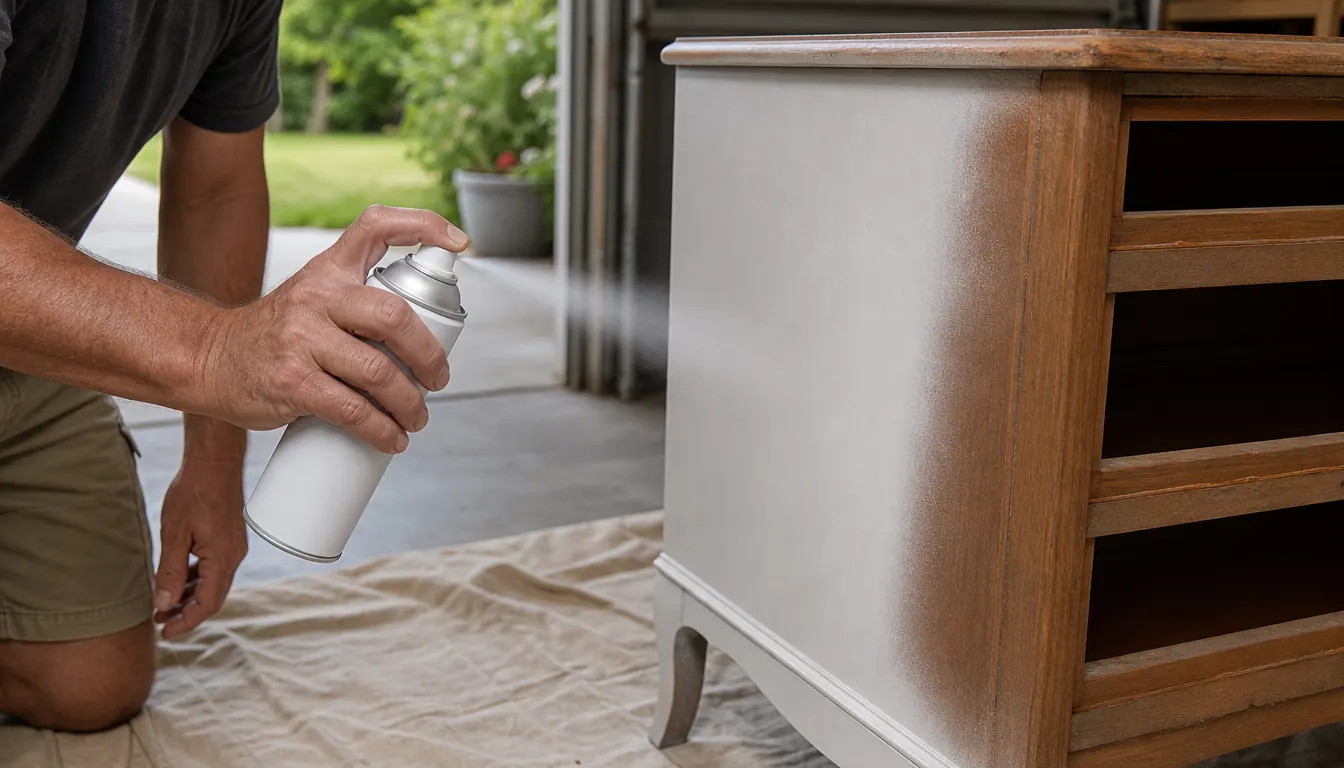
Here is where I used to overdo it. I would sand a piece down to bare wood, spend an entire afternoon on it, and then be too tired to actually paint. With this spray paint, that kind of heavy prep is not necessary. I wiped the nightstand down with a damp rag and a little dish soap to get the dust and grease off, let it dry, and then went over the shiny spots with a medium-grit sanding block, 120 grit, the same one I keep in the craft room for small projects. I did not press hard. The goal is a dull, even surface, not a smooth one, just enough rough-up so the paint has something to grab. I paid special attention to the top edge and the drawer front, because those were the spots where the old finish had worn shiny over the years, and shiny is exactly where paint likes to peel. The whole prep took maybe twenty minutes.
One thing I will say plainly: you do still need to sand a little. I skipped it on the drawer front because I was in a hurry, and that is the one spot where the finish did not adhere as well. It is not ruined, but I can see a thin line where the paint did not bite into the old finish. Ten minutes with the sanding block would have fixed it.
After sanding, wipe the piece down again with a tack cloth or a lint-free rag to get the dust off. Then set your piece up on a drop cloth in the garage. I put mine on two sawhorses with a piece of cardboard underneath, which meant I could walk all the way around it without stooping. That made the painting step dramatically easier.
Step 3: Shake, test, and spray in thin, even passes
Shake the can for a full minute. Not a quick jiggle, a real minute. I set a timer on my phone the first time because I did not believe it mattered, and it does. Then spray a quick test burst onto the cardboard before you point the can at your furniture. You want to see a fine, even mist, not spatters. If it spatters, the can needs more shaking or the nozzle needs a wipe.
Hold the can about ten to twelve inches from the surface and keep it moving. Start the spray before the surface and stop it after, like you are painting a line past the edge. Thin, even passes, overlapping each pass by about half. The first coat will look patchy and you will be tempted to lay it on thick. Do not. Thick coats run and drip, and then you get to learn whether you are patient enough to sand out a drip. I am not, so I learned to go thin.
The Rust-Oleum Chalked Spray Paint dries to the touch in about 30 minutes, which means you can do a second coat in the same afternoon without losing your momentum. I did three thin coats on the nightstand, waiting about 45 minutes between them to be safe. The finish came out smooth and velvety, exactly the matte chalk look I was after.
Step 4: Let it cure before you reassemble
This is the step I rushed, and I am telling you so you do not have to learn it the same way. Dry to the touch in 30 minutes is not the same as cured. I put the drawer pulls back on the nightstand after only a couple of hours, and I left fingerprints in the paint around one of the screw holes. I did not notice until the next morning, when I carried the piece inside and the light came through the garage window at an angle. There they were, three smudges around the top screw hole of the left pull. I tried to buff them out with a soft cloth, but by then the paint had cured enough that buffing only made them shinier. My only real fix was to sand that spot and repaint the whole drawer front, and I decided I could live with the smudges instead. They are still there, faint but visible, and every time I look at that nightstand I see them.
Give the piece at least 24 hours before you put the hardware back on or move it inside. Overnight in the garage is ideal. The paint will still be a little tender at the edges, so carry the piece by the bottom and do not stack anything on top of it. I left mine on the sawhorses until the next morning, then carried it into the craft room and let it sit for another day before I put the drawer back in.
Step 5: Protect the finish and put the piece to work
Chalk paint has a beautiful matte finish, but it is not armor. I do not use a sealer on pieces that will just sit and look pretty, like the little shelf I painted for the guest bath. But for the nightstand, which holds a lamp, a stack of books, and the occasional cup of tea, I wanted a little more protection. I used a clear furniture wax, applied thin with a small lint-free cloth in slow circles, let it sit for twenty minutes, and then buffed it with a soft cloth. It deepened the color slightly and gave the surface a soft sheen without turning it glossy. One coat of wax was enough for the nightstand. If the piece gets heavy use, I would add a second thin coat the next day.
If you skip the wax, just be careful with the piece for the first few weeks. Wipe up spills quickly and do not set anything hot or wet directly on the surface. The Rust-Oleum Chalked Spray Paint is not waterproof, so a sweating glass of iced tea will leave a ring if you let it sit. A coaster is your friend.
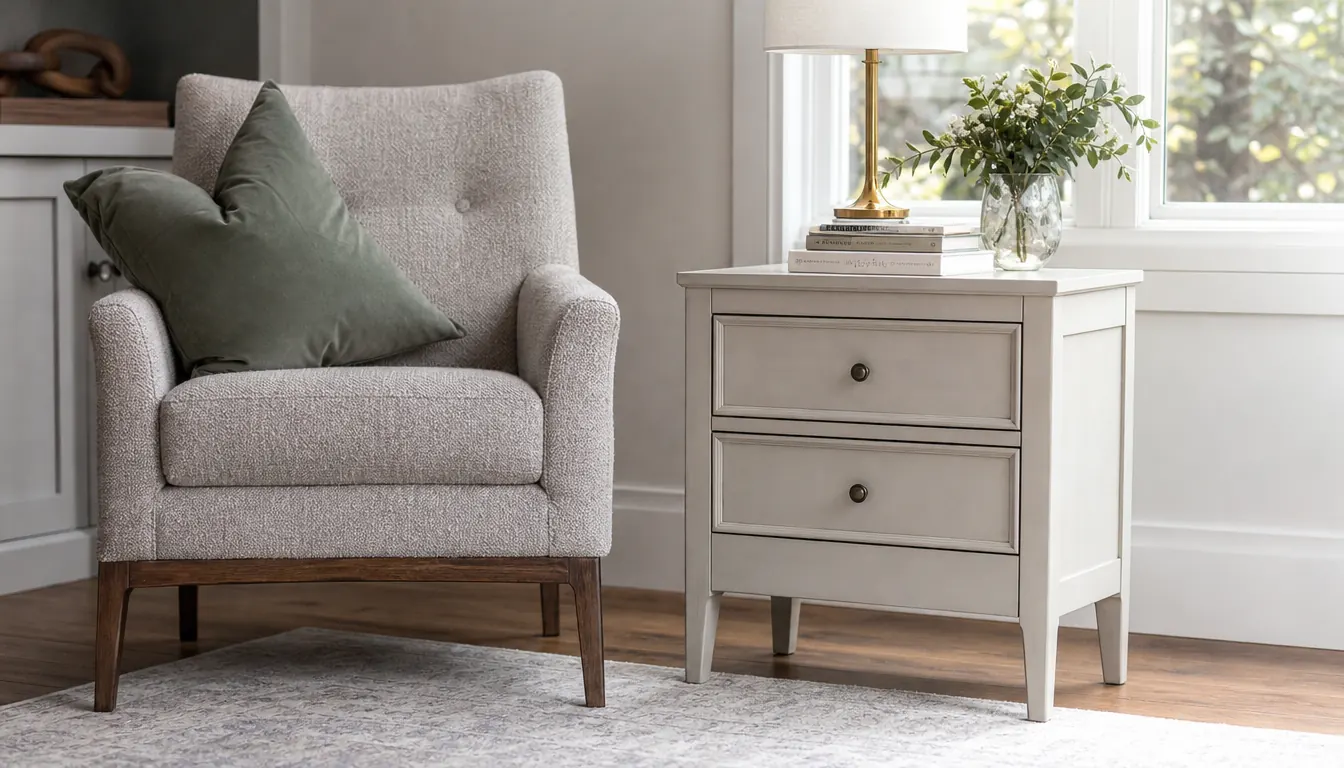
That nightstand now sits in our guest room next to the reading chair. It holds a small lamp, a stack of library books, and a little ceramic dish for Ron's pocket change. The drawer still sticks a little on humid days, but that was true before I painted it and it is not the paint's fault. The piece looks like it cost ten times what I paid for it, and I get a small thrill every time I walk past the guest room door.
What Else Helps
A few things made this project easier than my earlier attempts. A drop cloth you do not care about, because overspray happens. A pair of cheap nitrile gloves, because the paint cleans up with soap and water but your hands will thank you. A small sanding block and a tack cloth for between coats. And a fan pointed out the garage door, which made the low-odor paint feel even lower. I also keep a box of cardboard scraps under the workbench for test sprays, so I never have to aim a fresh can at a piece of furniture before I have seen what it will do.
If you are painting something with a lot of spindles or turned legs, like a chair or a plant stand, this spray paint is honestly easier than a brush-on chalk paint. The spray gets into the nooks and crannies that a brush cannot reach without leaving streaks. I painted a little plant stand for my sister-in-law last month, a piece with four turned legs and a ring of spindles under the top, the kind of detail that takes forever with a brush. I did not even take it apart. I sprayed it upside down first for the legs, then right side up for the spindles and the top, and the paint settled into every groove without a single streak. She asked me what kind of brush I used. I told her I did not use one. Start to finish, it took me maybe an hour of actual spraying.
The nightstand cost twelve dollars, took one afternoon of actual painting, and now looks like it came from a real furniture store. That is the whole argument for this can.
Start with the can that made my nightstand project finish in a weekend
The Rust-Oleum Chalked Spray Paint is made for interior wood, covers about 150 square feet, dries to the touch in about 30 minutes, and cleans up with soap and water. If you have a piece of old furniture waiting for a second chance, this is the easiest way I have found to give it one.
Amazon Check Today's Price on Amazon →